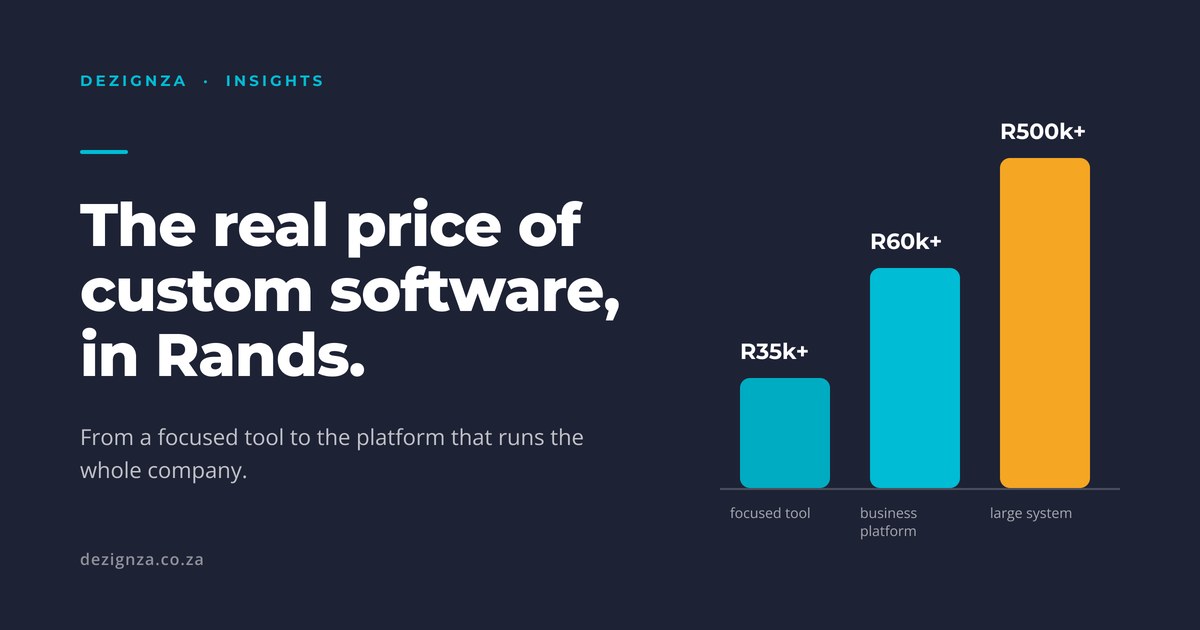
Custom web apps in South Africa run from about R35k for a focused tool to R500k and beyond for a large system. The number is driven by logic, not pages.
- Roles, integrations, data complexity, design depth and scale decide the price
- A Rand-billed local studio is usually cheaper over the life of the project than an offshore quote
- Build custom only when your process is the thing that makes you money
- We quote in writing, in phases, so you can launch early
It is the first question every business owner asks, and the hardest to get a straight answer to: what does a custom web application actually cost in South Africa? Agencies hedge, offshore shops quote a number that balloons later, and freelancers guess. Here is an honest breakdown, in Rands, from a studio that builds these systems every week.
The short answer
- R35k to R60kA focused single-purpose toolBooking system, client portal, internal dashboard
- R60k to R200kA multi-module business platformRuns a real operation, several screens and roles
- R500k+A large system built to scaleMany user roles, integrations, ongoing growth
Most custom web applications in South Africa fall between R35,000 and R500,000+. The range is wide because “custom web app” covers everything from a smart form to software that replaces nine spreadsheets and runs a 200-seat company. A focused tool starts at the low end; a platform that several teams live in all day sits in the middle; a system with many roles, integrations and real scale runs past the top.
What actually drives the price
Cost is not about pages or screens. It is about how much logic sits behind them.
Five things move the number more than anything else:
- Number of user roles An app with one kind of user is a fraction of the cost of one where admins, staff, clients and the public each see something different, with permissions to match.
- Integrations Payment gateways, accounting software, SMS and email providers, existing databases. Each connection is real work, and some third parties make it harder than others.
- Data complexity A booking calendar is simple. Commission maths, multi-currency billing, reconciliation or a recommendation engine is not.
- Design and UX depth A functional interface is quick. A researched, tested one that non-technical staff actually enjoy using takes more time, and usually pays for itself.
- Scale and reliability Software for ten users and software for ten thousand are engineered differently from day one.
Why offshore “bargains” often cost more
A quote in dollars can look cheaper until you add the hidden costs: the time-zone gap that turns a one-day decision into a one-week email chain, the rework when the team never understood your business, and the day you need support and nobody answers.
A studio that bills in Rands, understands South African payment gateways and POPIA, and picks up the phone is frequently cheaper over the life of the project. Not more expensive.
Should you build custom at all?
Not always. If off-the-shelf software fits how you work, use it.
Custom earns its cost when your process is the thing that makes you money and no product fits it.
You know you are there when you are bending your business around software instead of the other way around, or paying per-seat fees that grow faster than you do. That is the point at which a bespoke build stops being an expense and starts being leverage.
How we quote
We never quote a real number off a one-line brief. The estimate is issued in writing, in Rands, with no surprises.
- Understand What the software has to do, who uses it, and what it replaces.
- Scope into phases So you can launch something useful early and grow it as budget allows.
- Price in writing A written estimate in Rands, with what is in and what is not.
Wondering why a build still takes weeks when AI can write the code in an hour? Here is where the time actually goes.
Ready for a real number?
A few questions and a person comes back to you, usually within one working day.