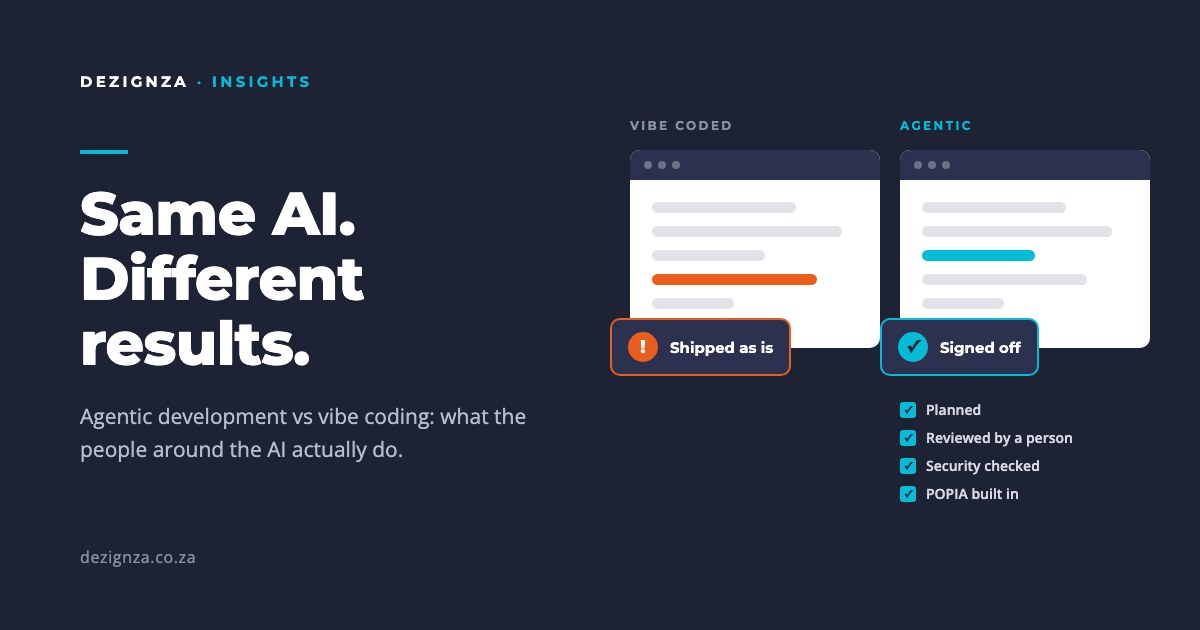
Anyone can build a website in five minutes with AI. We use the same AI agents every day. What you pay for is everything around them: the planning, the checking, the security and the people who decide what goes live.
- Vibe coding ships whatever the AI writes. Agentic development puts the same AI inside a proper process
- The risk in a quick build sits in what you cannot see: data leaks, privacy and POPIA
- Every DezignZA change is reviewed by an experienced developer before it goes live
- Five questions to ask anyone who builds your website or app
A friend tells you he can build your website in five minutes. Your nephew says he can knock out your booking app over the weekend with AI.
He is probably not wrong. AI has changed how software gets made, and we are not going to pretend otherwise.
We build with AI agents every day. It is a big part of why our projects move faster and why custom software is a smarter investment now than it was a few years ago.
So if we use the same tools as everyone else, what are you actually paying for? That is what this article answers.
Two ways to build with AI
Describe what you want, let the AI write it and ship whatever comes out. If it looks right on screen, it is done.
The same AI agents, but inside a proper process. People with real experience plan the work, give the agents clear jobs, check every result and decide what goes live.
Think of it like building a house. A weekend DIYer and a building contractor can buy the same power tools. Both can put up a wall. Only one has plans, inspections and a site foreman, and only one will sign off that it is safe to live in.
Same power tools. Only one of them signs off that it is safe to live in.
We wrote about what you can and cannot trust AI with in September. This article is about the other half: what the people around the AI actually do.
What the five-minute build leaves out
A quick build covers everything you can see. The risk sits in what you cannot see.
- 170of 1,645 AI-built apps were leaking user dataEmails, payment details and personal debt amounts
- 89%of workers have put company data into AI toolsAlmost a third have entered passwords or access keys
- R5 millionPOPIA fine issued by the Information RegulatorThe Regulator has moved from warnings to fines
- Who can see whose data In 2025, security researchers scanned 1,645 apps made with one popular AI app builder. 170 of them were leaking user data, including emails, payment details and even personal debt amounts. The apps looked finished. The problem was one missing security setting that nobody knew to check.
- Where your private information goes Paste a client list or a contract into a public chatbot and it now sits on someone else’s servers. A 2026 Zapier survey found that 89% of workers have entered company data into AI tools, and almost a third have entered passwords or access keys.
- POPIA The Information Regulator has moved from warnings to fines. It has issued a R5 million fine to the Department of Justice, and in October 2026 it fined FNB R1 million and a Johannesburg college R500,000. It has even confirmed that an email sent to the wrong colleague can count as a security breach.
- What happens after launch Updates, backups, new security flaws, the outage at 2am. A five-minute site has no plan for year two.
- Whether it should be built at all AI will build whatever you ask for. It will not tell you a feature is a bad idea, or that a simpler fix would save you months.
How we work
We will not give away the recipe, but here is what every DezignZA project gets.
- A plan before any code Every project runs on our own project management platform, from the first brief to launch and beyond. Nothing lives only in someone’s head.
- Agents do the heavy lifting. People make the calls. Every change is reviewed by an experienced developer before it reaches your live site. Agents work on copies, never on your live data.
- Your data stays private Sensitive client information is handled by private AI models that run on our own machines. It never gets pasted into public AI tools.
- Security checks before launch, and after Every build is checked before it goes live, and checked again when new flaws are announced.
- POPIA as standard Privacy is built in from day one, not bolted on at the end.
- Twenty years of knowing what goes wrong We have been designing and building for the web since 2005, first in Ireland and now in Somerset West, for everyone from local schools to international brands.
Proof, not promises
In October 2026, several serious security flaws hit the web within days of each other. While many site owners were still reading the headlines, we had already checked and patched dozens of client apps and websites. You can read what happened and what we did.
When something breaks out there, we already know which of our clients’ sites are affected and what needs fixing.
Five questions to ask anyone building your website or app
Whoever you hire, us or someone else, ask these first.
- Where does my business and customer data go while you build?
- Who checks the work before it goes live?
- How do you make sure one customer can never see another customer’s information?
- What happens when a new security flaw is announced next year?
- Is my project POPIA compliant, and can you show me how?
A good developer answers all five without hesitating. If the answer is “the AI handles that”, keep asking.
The bottom line
AI made building faster. It did not make judgement, experience or responsibility any less important.
If your website is a hobby, the five-minute build is fine. If it holds customer data, takes payments or runs part of your business, it needs a team that has seen what goes wrong and builds so it does not happen to you.
Wondering what a properly built app would cost? Start with our guide to custom web app costs in South Africa, or get a quote and we will talk it through.
Want it built properly?
A few questions, and a person comes back to you, usually within one working day.
- Superblocks, Lovable Vulnerability Explained: How 170+ Apps Were Exposed, 2025.
- Zapier, 79% of workers have entered sensitive info like logins into AI, July 2026.
- BusinessTech, Two departments nailed with R5 million fines in South Africa, September 2026.
- Accounting Weekly, Information Regulator fines FNB R1 million and a TVET college R500,000 under POPIA, October 2026.
- Werksmans, When a misdirected email becomes a data breach, 2026.